Getting started as a coach or therapist
What Specthrive does for a professional today — your Clients page, inviting someone, what you can see, and how to share a task.
Specthrive gives you one place for the people you support: who you are working with, what they are working on, and a quiet way to put a single next step in front of someone. The families on the other side of it are often tired and doing a lot alone, so the professional side is built to stay light and stay out of the way.
This guide covers your account, your Clients page, inviting someone, what you can see once they join, and how to send a task. The same relationship seen from the family's side is in Working with a coach or therapist.
Your account
You sign up as yourself. It is an ordinary Specthrive account, in your own name, with your own login. The professional side is not a second account to keep track of.
Specthrive verifies professionals by hand. A person reviews your account before the professional tools open up. Once that is done, a Clients item appears in your navigation, and the rest of this guide starts there.
Your Clients page
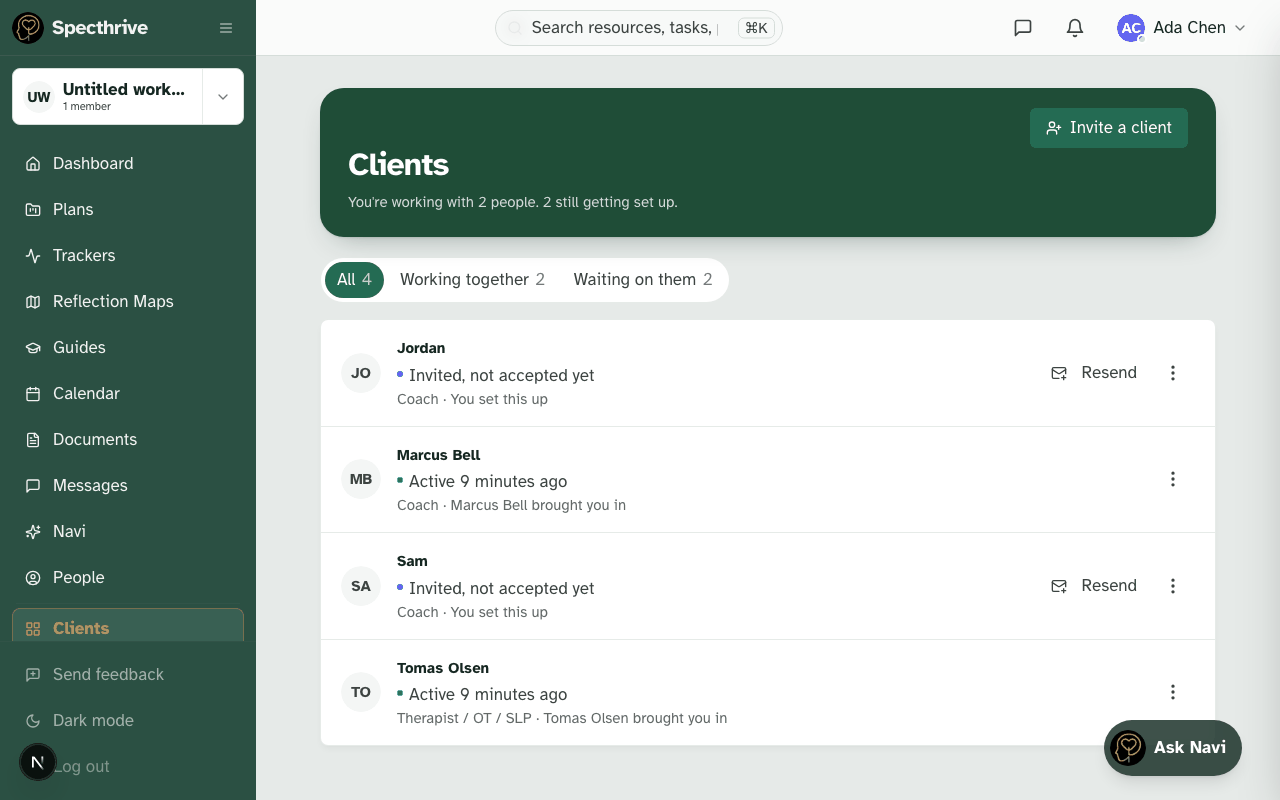
One list, whichever way the engagement began. /clients holds the people you invited and the people whose family added you from their side. The same people also show up on /people, under "People you work with" — /clients is simply the page built for this work.
Each row is a name, a coloured dot, a short line about where things stand, and a third line naming your role and how the engagement began — "Coach · You set this up", for example. The status line reads "Active 2 days ago", "Invited, not accepted yet", "Not invited yet", "Invite didn't reach them" — a sentence rather than a score, on purpose. The page tells you where someone is; it does not rank them.
Filters appear when they help. Once you have at least one engagement under way and at least one person still getting set up, three filters show up: All, Working together, and Waiting on them. Until then the list stands on its own.
Inviting a client
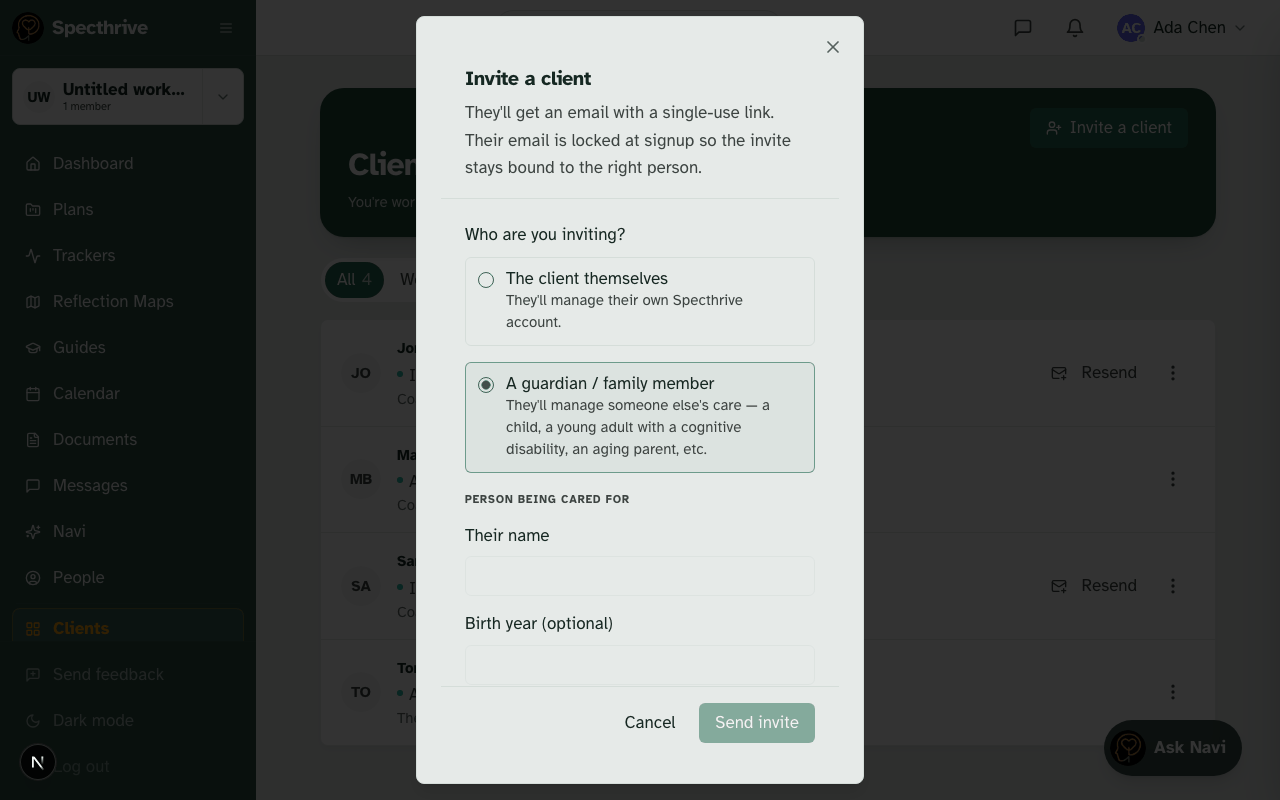
Invite a client starts with one question: "Who are you inviting?" The two answers are The client themselves, who will manage their own Specthrive account, and A guardian / family member, who manages someone else's care. The answer shapes everything that follows, so it is worth a moment before you type an email address.
The invitation you send from here is single-use and good for 14 days. If it goes stale or lands in the wrong inbox, Resend issues a fresh link and stops the old one working.
Who will manage the account matters more than anything else on this screen. If the person you support is going to run their own account, choose The client themselves. If a parent or guardian will run it for them, choose A guardian / family member — that is the right answer whenever someone else is responsible for their care decisions. The two paths are not interchangeable, and changing your mind later means starting the invitation again. If you are not sure which one fits, talk to us before you send it.
What your client sees
There are two different invitations, and they open different screens.
The invitation you send from Invite a client opens a welcome page with your name on it — that you invited them, your role underneath, and a line saying you have set up a private space for them. The button reads Create my account, which leads to the signup form — where, once the invite resolves, their email address is already filled in and cannot be edited. There is nothing to accept or decline on the welcome page, and no list of areas to approve; it already knows who sent them.
Handing over a profile you prepared is the other one. If you set a profile up and then invite that person to take it over, their link opens a screen headed "{your name} set this up for you", with a card further down labeled "What {your name} can see" — listing each area switched on, with a note that they can turn off anything they would rather keep private, and change it later. They can narrow what you see; they cannot widen it. Signed in, the button reads Approve and continue; signed out, it reads Sign in to continue first. That is a different link from the one above, and it runs for 7 days rather than 14.
Before they finish setting up
You can put a little in place first, for someone who is claiming their own profile. Plans and trackers can be added before they finish setting up, so the first thing they see is not an empty page.
Only plans and trackers work this way, and the window closes the moment they complete their own setup. From then on the profile is theirs, and the ordinary sharing rules take over.
What you can see afterwards
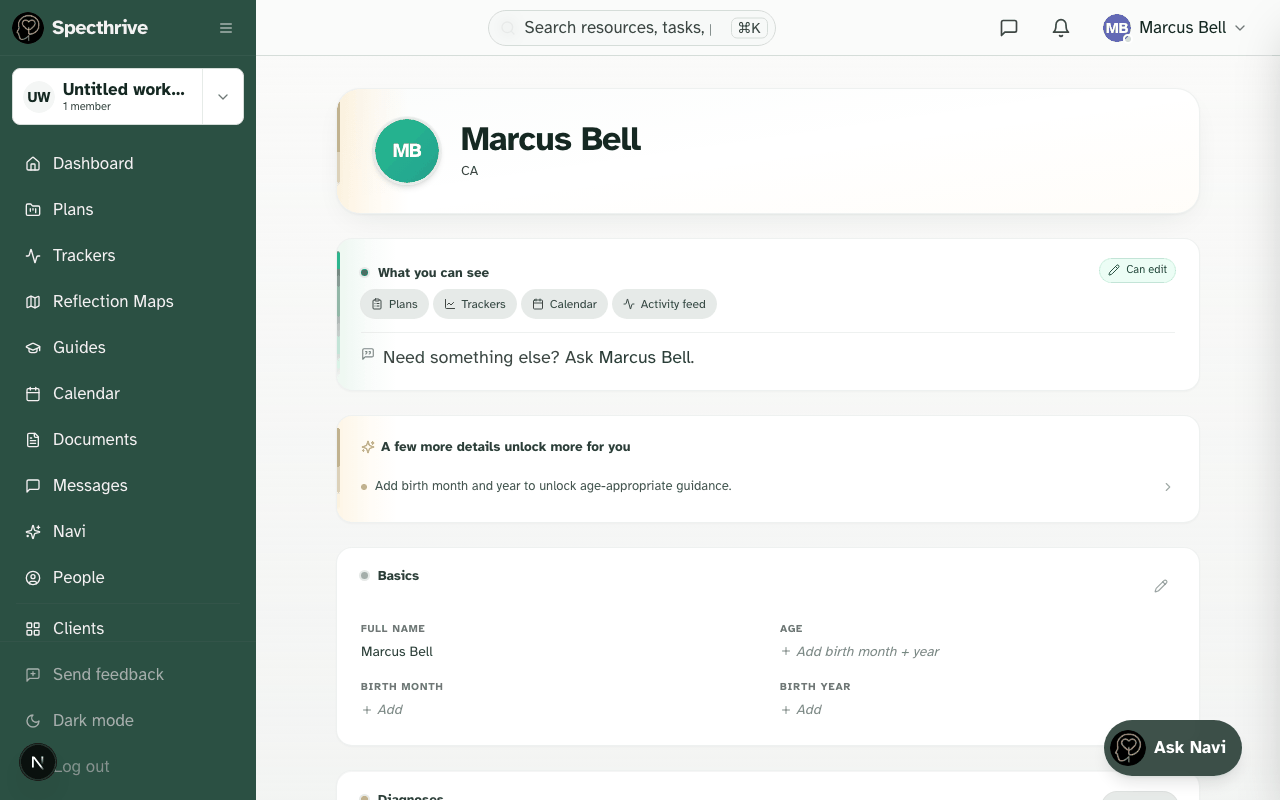
Access is granted per area, and it starts from your role. A coach starts with plans, trackers, calendar, and activity feed. A therapist starts with those plus timeline and reflections.
Documents are in no preset, and neither are messages. Those are shared deliberately or not at all, by the person whose profile it is.
They stay in charge of all of it. Whoever owns the profile can change any area at any time, without telling you. An area that closes is not a verdict on your work.
Sharing a task
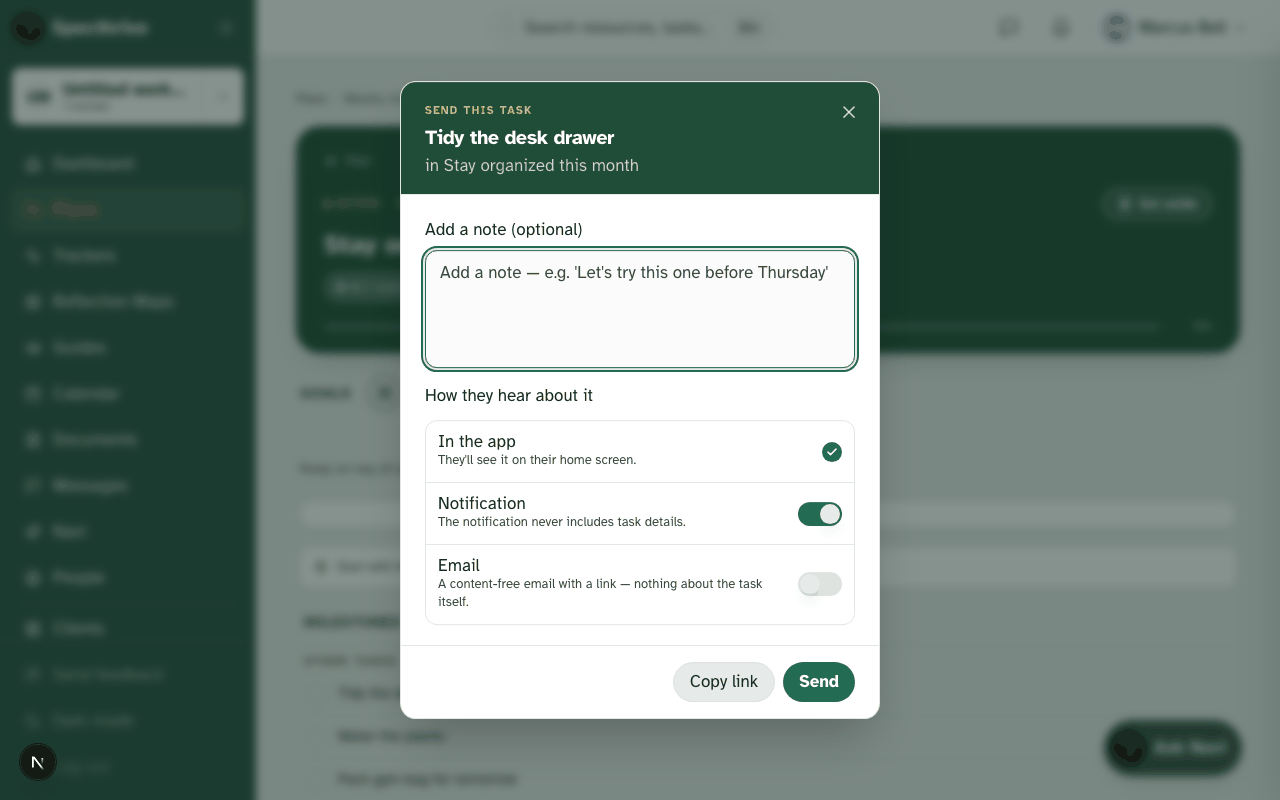
Open a task on one of their plans and the action reads Send to their first name. A sheet titled "Send this task" opens, with room for a short note of up to 280 characters if you want to add one.
What reaches them carries nothing about the task. Not the title, not your note. They learn that you sent something and get a link to it; the task and the note are waiting when they open it.
You will not see whether they read it. That is deliberate. A nudge you can check up on stops being a nudge.
Guides
Guides are structured plans developed with clinicians — a domain, a stage, and a set of goals already laid out. You can read through one the same way a family does.
A client who opens a guide can use Add to My Plans to take a copy onto their own profile, where it becomes theirs to edit. Pointing someone at a guide is often gentler than handing them a blank plan.
Ending an engagement
Which exit sits on the row depends on who started the engagement. One you began ends with End engagement… in the client's row menu. One a family began, by adding you from their side, ends with Leave this client's team instead — that access was theirs to give, so the move is to hand it back.
Ending one you started closes your access to that person's plans, goals, tracker entries, and your messages with their team. They keep everything, and can invite you back later if they choose. Nothing is sent to them, so if it is something they should hear from you, tell them first.
Leaving a team you were added to closes your access to their plans, trackers, and your messages with their team. Their family is told that you left, and only they can invite you back.
Getting help
If something here does not match what you see on your screen, or you have a question about an account, get in touch.
Still have a question?
If this guide did not cover your situation, reach out. We read every message.